The Complete Guide to Local SEO for Lawyers (2026 Edition)
 CounselRank Team
·
·
19 min read
CounselRank Team
·
·
19 min read
The Power of Local Search for Law
Among American lawyers, marketing a law firm and self-marketing for attorneys is nearly looked down on. If you’re a qualified smart attorney, you won’t need any ads, for your fame is passed around through word of mouth.
But what does a person who’s just suffered a bike accident know about your awards and fame? They need an attorney nearby right now, with an adequate number of reviews and a decent rating. That coupled with quality content on your website may make it the destination for your clients.
The face of your local search performance is your Google Maps listing or Google Business listing. If kept clean and updated, it may be a powerful storefront for your law practice.
Defining Local SEO for Lawyers
Local SEO is the discipline of making your firm visible when someone nearby is searching for legal help right now. It is distinct from general search optimization in one important way: the results are filtered by geography. A search for “divorce lawyer” returns a broad, often national set of results. A search for “divorce lawyer near me” or “criminal defense attorney in Chicago” triggers a different system — one that weighs where the searcher is, where your firm is located, and how clearly your online presence signals relevance to that place and that matter.
The major levers are your Google Business Profile, the consistency of your name, address, and phone number across the web, location-specific pages on your site, and the authority signals — reviews, citations, local links — that tell Google your firm is an established presence in a particular geography.
The “Why”
Today’s search engines are designed to deliver the most relevant answer to a query as fast as possible — and for most legal searches, relevant means local. To appear in those results, your firm needs to exist both as a credible online entity (SEO) and as a verifiable physical presence on Maps (local SEO).
The competitive window is narrow: over 90% of search traffic goes to page one results, and fewer than 1% of users click through to page two. In practical terms, a firm that ranks outside the first page is, for most practical purposes, invisible to the people actively searching for help right now.
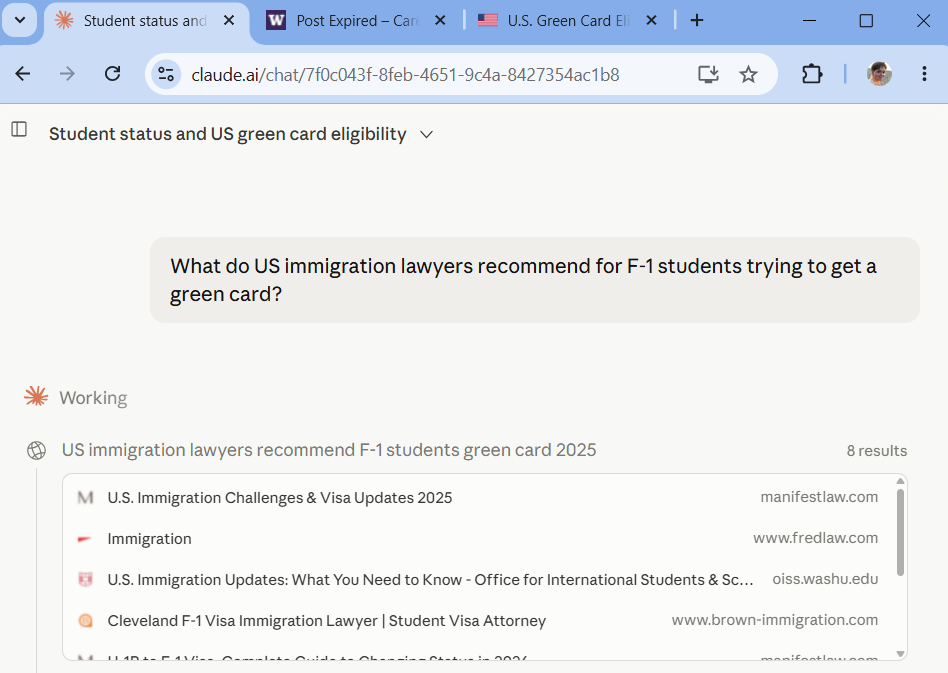
Claude is actively checking most relevant and well-structured lawyer blogs to inform its answer.
The Advantage
This context is an opportunity for smaller law firms, solo practices and other local businesses. They can dominate hyper-local markets — a neighbourhood, a district, a county seat — that larger regional firms routinely overlook. A firm that becomes the recognized answer for “estate planning attorney in City” or “DUI lawyer near Suburb” does not outrank anyone nationally, but it is the go-to for search engines in that specific place. In local search, specificity is a structural advantage.
The leads that come from local organic visibility are closer to a decision, more geographically matched to your practice and less expensive to acquire than those chased through broad keyword bidding.
Core Ranking Factors: How Google Decides
Local SEO becomes a real lever when you understand Google’s local ranking algorithm, which operates on three signals: proximity, relevance and prominence.
- Proximity is the distance between your office and the person searching. When someone types “lawyer near me,” Google uses their real-time location to filter results geographically. This signal is largely fixed: you cannot optimize your way around it. What you can control is making sure Google knows precisely where you are.
- Relevance is Google’s assessment of how well your firm matches what the searcher actually needs. The lever here is specificity: dedicated service pages for each practice area, written in the language potential clients actually use when they search, tied to the geographic markets you serve. Relevance is built through content structure — and it is one of the few ranking signals a firm can improve materially without outside help.
- Prominence is the broadest of the three signals and the hardest to manufacture quickly. It measures how well-established and trusted your firm appears across the web: through reviews on your Google Business Profile, through backlinks from local bar associations and legal directories, and through mentions where your firm’s name, address and phone number appear consistently across directories and third-party sites. Prominence is not built in a week, but it is built systematically.
These three signals do not operate in isolation. A firm with strong proximity but thin relevance signals will lose to a competitor two miles further away whose service pages are precise and whose GBP is fully built out. The firms that rank consistently well have addressed all three — not perfectly, but deliberately.
Optimizing Google Business Profile (GBP)
Your Google Business Profile is the most direct signal you can send to Google about where your firm is, what it handles, and whether it is an active, trustworthy practice. It is also the most commonly underdeveloped asset in legal local SEO.
Claiming and verification
The point of claiming your profile is to verify that your firm occupies a real physical location. Google requires this verification precisely because local results are supposed to reflect actual geographic presence. Shortcuts like virtual offices and shared addresses create compliance risks that can surface later as suspensions, and recovery is slow and uncertain.
Completing your profile
A complete profile gives Google more to work with and gives potential clients more reason to call. Two fields carry more weight than most firms realize.
- NAP (your Name, Address, and Phone number) need to be accurate and consistent — across Google and every directory, legal listing and citation your firm appears in online. Google cross-references these signals. A suite number formatted differently on one directory, a phone number that has not been updated after a move, an old firm name still appearing on an aggregator site — any of these create noise that suppresses local rankings.
- The primary business category is the field where Google sees you working. Selecting “Personal Injury Attorney” rather than the generic “Law Firm” tells Google precisely which searches your profile should appear in.
💡Best Practice: Set your primary category to the most specific practice area your firm handles — “Personal Injury Attorney” rather than “Law Firm.” Then add secondary categories for each additional area. Most firms set one category at setup and never return to it. A five-minute review of your category list is one of the faster visibility wins available.
Active engagement
Google reads activity as a proxy for relevance. Firms that post updates, respond to reviews, upload current photos of their office and team and use the Q&A section to address common client questions consistently outperform static listings in local rankings. A short post every two weeks and a prompt response to each new review is enough to keep the profile alive and signalling trust.
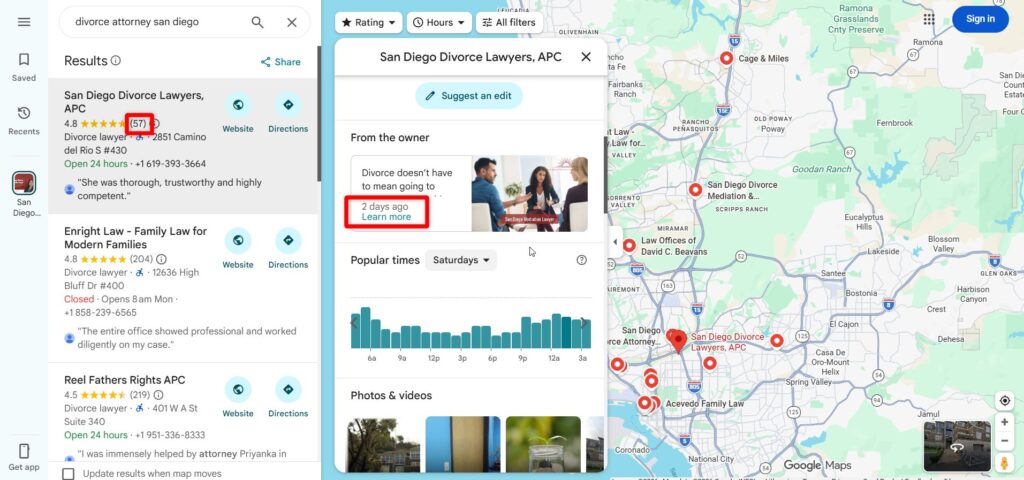
The first search result still leads thanks to active posting, despite having fewer reviews.
Avoiding Suspensions
A suspended Google Business Profile is removed from local search results entirely — no Maps listing, no local pack, no visibility. The practices that trigger suspensions are well-known and entirely avoidable:
- Stuffing keywords into a business name. Your profile name should match your firm’s actual registered name. Listing yourself as “Smith Law Personal Injury Lawyer Chicago” rather than “Smith Law” violates Google’s guidelines.
- Virtual or mailbox addresses. Google requires a verifiable physical location where the business operates. A shared office suite used once a week or a UPS Store address does not meet that standard.
- Frequent address changes. Updating your address repeatedly — particularly without a corresponding verifiable move — can trigger a review.
Reputation Management: Reviews as a Ranking Signal
Reviews are not a soft trust signal sitting at the edge of your marketing strategy. They are a direct local ranking input that Google weighs alongside your profile completeness and your site’s authority. Review maintenance is part of the visibility infrastructure, at times outperforming even technical SEO advantages.
Strategy
The firms that accumulate reviews consistently do one thing differently: they ask, systematically, at the right moment. After a matter closes well, a short message with a direct link to your Google review page removes every point of friction between a satisfied client and a posted review. One follow-up, sent a few days later if there has been no response, is reasonable and rarely unwelcome.
🛑Avoid: Do not offer anything in exchange for a review — gift cards, discounts, referral fees, or any other incentive. This violates Google’s review policies and can result in review removal or profile penalties. More importantly, incentivized reviews in a legal context raise bar ethics concerns in many states. A direct, timely ask after a matter closes well is both effective and compliant. An incentivized ask is neither.
The Trust Factor
When a potential client lands on your Google Business Profile, three things shape their impression almost immediately: your star rating, how recently your reviews were posted, and how your firm responded to the ones that were critical. A strong overall rating with reviews that stopped two years ago tells a different story than a slightly lower rating with consistent activity over recent months.
The compounding effect is real: fresh reviews improve local rankings, higher rankings bring more profile visits, more profile visits produce more review opportunities. A steady, authentic review cadence is one of the few local SEO levers that builds both trust and search visibility at the same time.
Strategic Keyword Research & On-Page SEO
Researching and Implementing keywords
Keyword research is about understanding exactly how a potential client describes their problem before they know your name — and making sure your pages show up when they do.
The process starts with seed keywords: the core terms that describe your practice area in plain language — “personal injury lawyer,” “DUI attorney,” “immigration help.” On their own, they are too broad to be useful. You are not competing for “personal injury lawyer” globally. You are competing for “personal injury lawyer Austin” or “car accident attorney near me.”
This is where location modifiers turn seed keywords into targeted, rankable phrases:
- “lawyer near me” — high-intent, mobile-heavy, and driven by Google’s local signals
- “[city] personal injury lawyer” — the clearest signal of geographic intent
- “best DUI attorney [city]” — competitive, but valuable where trust language matters
Once you have identified the right keyword combinations, placement follows a clear hierarchy:
- Title tags — the single most important on-page signal; match the search intent exactly
- Meta descriptions — not a direct ranking factor, but they affect click-through rate
- Headers (H1–H3) — structure the page logically and signal topical coverage to crawlers
- URLs — short, descriptive, and keyword-inclusive;
/brooklyn-criminal-defense-attorney/beats/page-id-4827/every time
FAQs: The Visibility Gap Left Open
If keyword placement is foundational, the FAQ section is where most law firm websites quietly give up visibility they could easily claim.
This is where AEO — Answer Engine Optimization — enters the picture. AEO is the practice of structuring content so that search engines and AI assistants can extract a direct, usable answer to a specific question. It is the reason some law firm pages appear in Google’s featured snippets, AI Overviews, and the answer panels that now sit above traditional search results.
The questions should reflect what people actually search. Not “Why should I hire a personal injury attorney?” but “What should I do after a car accident in Houston?” A page that answers that question directly — in two or three clear sentences — is far more likely to be surfaced than one that talks abstractly about the value of legal representation.
💡Best Practice: Structure each FAQ answer the same way: lead with a direct one-sentence response to the question, then add one or two sentences of necessary context or qualification. AI systems favor content that states the point first and elaborates second. Write the answer you would give in a hallway conversation, then add the bar-aware qualification at the end.
Example: “If you were in a car accident in Houston, your first steps are to document the scene, exchange details with the other driver, and notify your insurer within 24 hours. Before accepting any settlement, speaking with a personal injury attorney can help you understand what you are actually owed.”
Done properly, the FAQ section simultaneously improves your visibility in traditional search, earns placement in AI-generated answers, and builds immediate trust with a reader who arrives unsure and uncertain.
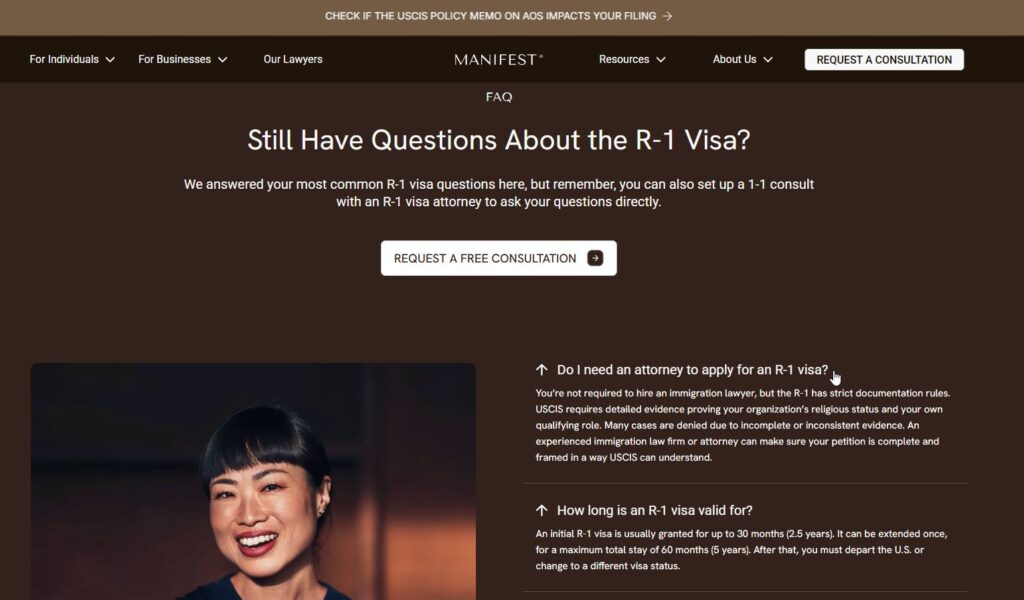
The law firm provides an FAQ section on its service page and gives laconic, on-point answers.
Technical SEO & User Experience
Mobile-First Design
Most people searching for an attorney are doing it on a phone — often in a moment of stress, from a waiting room or a parked car. If your site loads slowly, is hard to read on a small screen, or buries your phone number behind three taps, you lose them before they ever read your name.
The standard is straightforward: your site should load in under three seconds on a mobile connection, display clearly without horizontal scrolling, and surface your contact options without making a visitor hunt for them.
What to check:
- Page speed: Use Google’s PageSpeed Insights to identify what is slowing your site down. Large image files and unused code are the most common culprits.
- Readability: Body text should be at least 16px. Paragraphs should be short. Walls of text do not hold attention on a four-inch screen.
- Contact accessibility: Your phone number and contact form should be reachable from any page in one action.
Schema Markup
Schema markup is structured data — code added to your site that tells search engines precisely what they are looking at. Without it, Google has to infer. With it, you state it directly.
For law firms, two schema types matter most:
- Attorney schema communicates professional identity: your name, your practice areas, your jurisdiction, your credentials. It helps Google — and increasingly, AI answer systems — understand not just that your site exists, but what kind of legal work you do and where.
- Local Business schema reinforces geographic relevance: your address, your service area, your hours, your phone number. When this data is structured consistently across your site and your Google Business Profile, it strengthens the local authority signals that drive Maps and near-me search performance.
Neither schema type is a ranking shortcut. What they do is reduce ambiguity — and in a category where many firms have thin, undifferentiated sites, clarity itself becomes a competitive signal.
Advanced Strategies for 2026
The fundamentals of legal visibility — clear structure, accurate information, consistent local signals — have not changed. What has changed is the environment in which those fundamentals operate. Search now surfaces results across multiple systems, including AI-generated answers, voice interfaces and map-based discovery.
Legal Ethics and Compliance
Bar compliance is not a footnote in legal marketing. It is a structural constraint that shapes what you can publish, how you can describe your services, and what claims you are permitted to make in any jurisdiction.
The most common compliance failures in legal SEO are routine: practice area pages that imply specialization without the required certification, location pages that suggest physical presence where none exists, and client outcome language that crosses into impermissible guarantees.
🛑Avoid: Outcome language on practice area pages is the most common bar compliance failure in legal SEO. Lines like “I’ve recovered millions for clients” or “We win the cases that matter” read as normal marketing to most people who write them. In many states, they constitute impermissible guarantees. The safer framing is consistent: describe what you do, how you approach the work, and what the process looks like — not what the client will get. Before any practice area page goes live, run the outcome language specifically against your state bar’s advertising rules.
A practical compliance baseline for any published page: clear practice area scope, no outcome guarantees, no unsupported designations, and state-specific review for any jurisdiction-sensitive claims.
AI Search and Generative Answers
AI-generated answers now appear prominently in Google Search for many legal queries. They are not replacing traditional results, but they are occupying space above them — and the firms whose content informs those answers are the firms that appear in them.
AI systems favor content that is specific, clearly structured, and factually consistent with other authoritative sources. The most useful content investment right now is not broader coverage — it is more precise coverage: pages organized around specific questions, written in plain language, supported by structured headings. Schema markup reinforces that structure at the technical level. Internal linking signals which pages carry the most authority within a topic area.
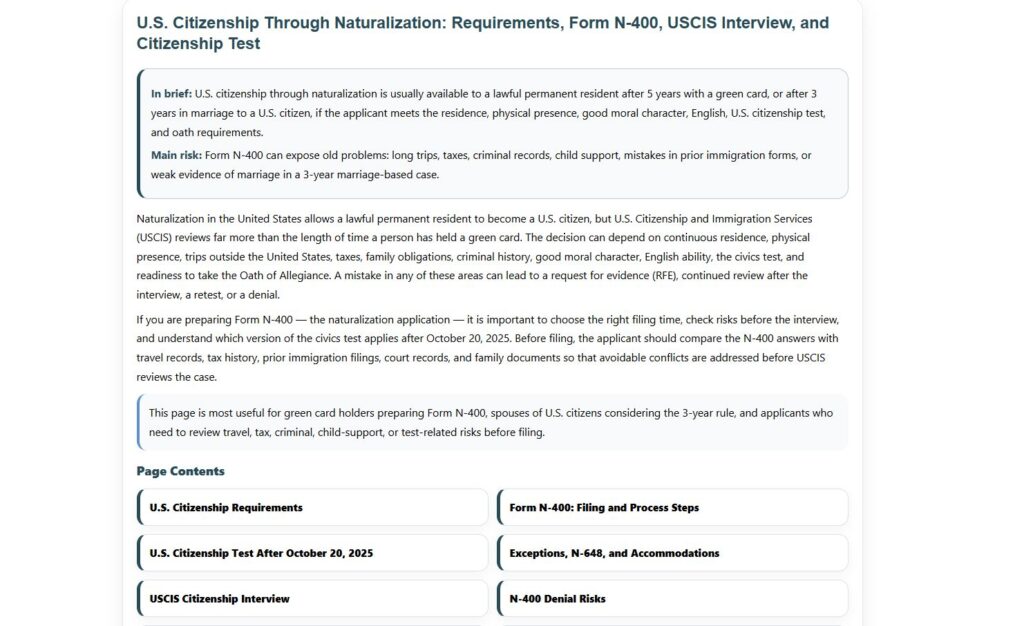
This page is given a clear content plan which makes it easier to crawl for search engines.
Accessibility
Accessibility is a baseline requirement, not an enhancement. Under Title III of the ADA, websites operated by businesses open to the public face ongoing litigation risk when those sites are incompatible with assistive technology.
The practical requirements are well-established: images need descriptive alt text, navigation needs to be operable by keyboard, color contrast needs to meet WCAG 2.1 AA minimums, and form fields need labels that screen readers can interpret. Accessible sites also tend to be better structured, faster to load, and more navigable for all users — accessibility work typically improves technical SEO as a byproduct.
Multilingual SEO
For firms serving communities where English is not the primary language, single-language content is a structural visibility gap. Spanish-speaking populations in the US conduct legal searches in Spanish at rates that reflect the same urgency and intent as English-language searches.
The key distinction is between translated content and native-quality content. Machine-translated pages rank poorly, generate high bounce rates, and often contain phrasing that is technically accurate but unfamiliar to native speakers. Multilingual SEO is worth pursuing when the underlying client demand exists in your geography and when the firm has the capacity to handle intake and consultations in that language.
Video and Local Discovery
Video content affects local visibility in two ways. First, it influences how potential clients perceive your firm before they contact you — an office walkthrough or a clear explanation of your intake process reduces friction for someone who has never retained an attorney. Second, video hosted on YouTube and embedded on your site creates an additional discovery surface within Google’s ecosystem.
The most effective local video content is specific rather than general: a walkthrough of your physical office, a brief introduction from the attorney who will handle the matter, a plain-language explanation of what happens after a potential client calls. Production quality matters less than clarity and authenticity.
Negative SEO and Reputation Defense
Most negative SEO threats affecting law firms are not sophisticated attacks. They are accumulations of neglect: outdated directory listings with incorrect information, spam backlinks acquired through old link schemes, and fake or incentivized reviews that violate platform terms.
Active monitoring is the most effective defense. A firm that reviews its backlink profile quarterly, watches its Google Business Profile for unauthorized edits, and checks its review velocity for unusual patterns will catch most problems before they compound. Fake reviews require a specific response protocol: document the review, report it to the platform, and respond publicly with a measured, factual statement that neither confirms nor denies client identity.
Reputation defense is not a reactive function. It is part of routine visibility maintenance. Firms that treat it that way rarely face crises.
Tracking, Analytics and ROI
Key Metrics
Most law firms track popular metrics — organic traffic, bounce rate and keyword rankings — that tell certain facts about the website but can barely inform any decision making. When assessing your website performance and SEO efforts, consider these narrower and more honest metrics:
- Organic traffic by page type. Distinguish between practice-area pages, location pages, blog posts and your homepage. A spike in blog traffic that produces no contact-form submissions is not a win. A modest uptick in traffic to your personal injury intake page in a target county almost certainly is.
- Conversion rate by source. How many visitors from organic local search take a qualifying action — calling, submitting a form, requesting a consultation? Track it separately from paid traffic, direct traffic and referral traffic, because those channels behave differently.
- Local pack appearance and click-through rate (CTR). Google Search Console shows impressions and clicks for queries where your firm appeared. If you are appearing in the local three-pack but your CTR is low, the problem is likely your profile, your reviews, or your primary category — not your rankings.
- Time to first contact. If your analytics are set up to track form submissions by page, you can see which practice-area pages actually drive intake inquiries. Pages that rank and convert deserve more content investment. Pages that rank and do not convert need a structural review.
Tools
- Google Search Console is the most important — and free — diagnostic tool available. It shows which queries are surfacing your pages, how often those pages appear in results and how often searchers click through. For local SEO, filter by location queries and monitor practice-area pages specifically.
- Google Analytics 4 connects traffic to behavior. It shows what searchers do after they arrive — which pages they visit, how long they stay, and whether they take any action. A basic configuration should at minimum track form submissions, click-to-call actions, and contact-page visits as distinct events.
- Google Business Profile Insights shows how many people searched for your firm directly versus discovered you through category or service queries, how many requested directions, and how many called directly from the profile. Someone who clicks for directions or calls from the Maps listing is typically a higher-quality prospect.
- BrightLocal or a comparable local SEO platform is useful for tracking local keyword rankings across the specific zip codes and cities you serve, and for auditing citation consistency across directories.
Ongoing Maintenance
Firms that treat SEO as a one-time project typically see early gains flatten within a few months. The search environment changes, competitors continue publishing, and Google updates its local ranking logic. The gap between an active profile and an inactive one compounds over time.
A realistic maintenance rhythm looks like this:
- Monthly work. Review Google Business Profile for new reviews and respond to them. Check for any automated profile edits that Google may have applied without notification. Run a citation scan to catch any new inconsistencies.
- Quarterly work. Audit keyword rankings for your primary practice-area and location combinations. Update practice-area pages to reflect any changes in your firm’s focus, geography, or notable matters. Review your GBP categories and service list for accuracy and completeness.
- Ongoing work. Publish new content with a consistent cadence. A firm that publishes two well-structured, bar-aware practice-area or FAQ pages per month, every month, builds a more durable content authority than one that publishes twenty pages in a burst and then stops.
None of this requires a large team or a complex workflow. It requires a clear process, accountability for who does each task and a willingness to treat local visibility as part of firm operations rather than as a marketing experiment.
CounselRank Team
Legal SEO & AI Visibility
CounselRank helps law firms grow local and AI visibility. We write about legal SEO, Google Business Profiles, and how AI search is changing the way clients find lawyers.